
 英文版
英文版 苏州大学
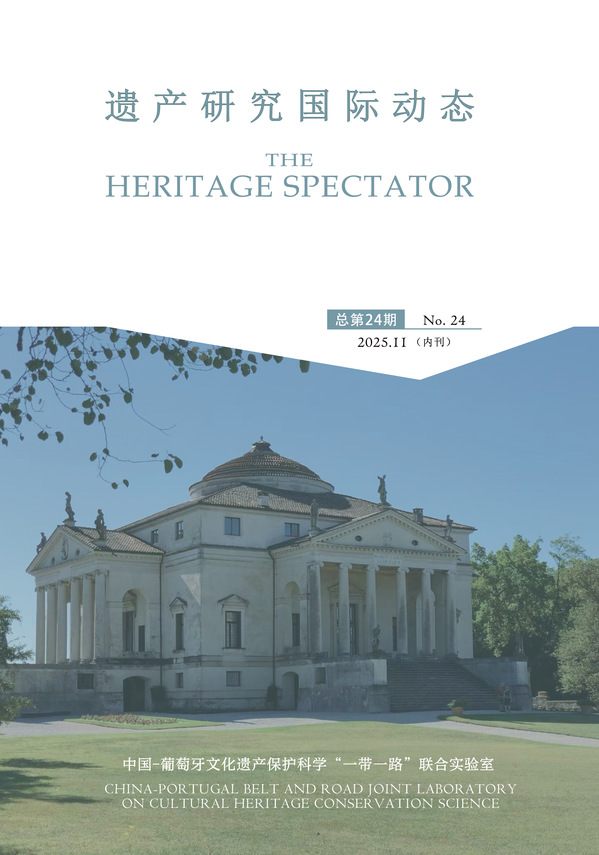
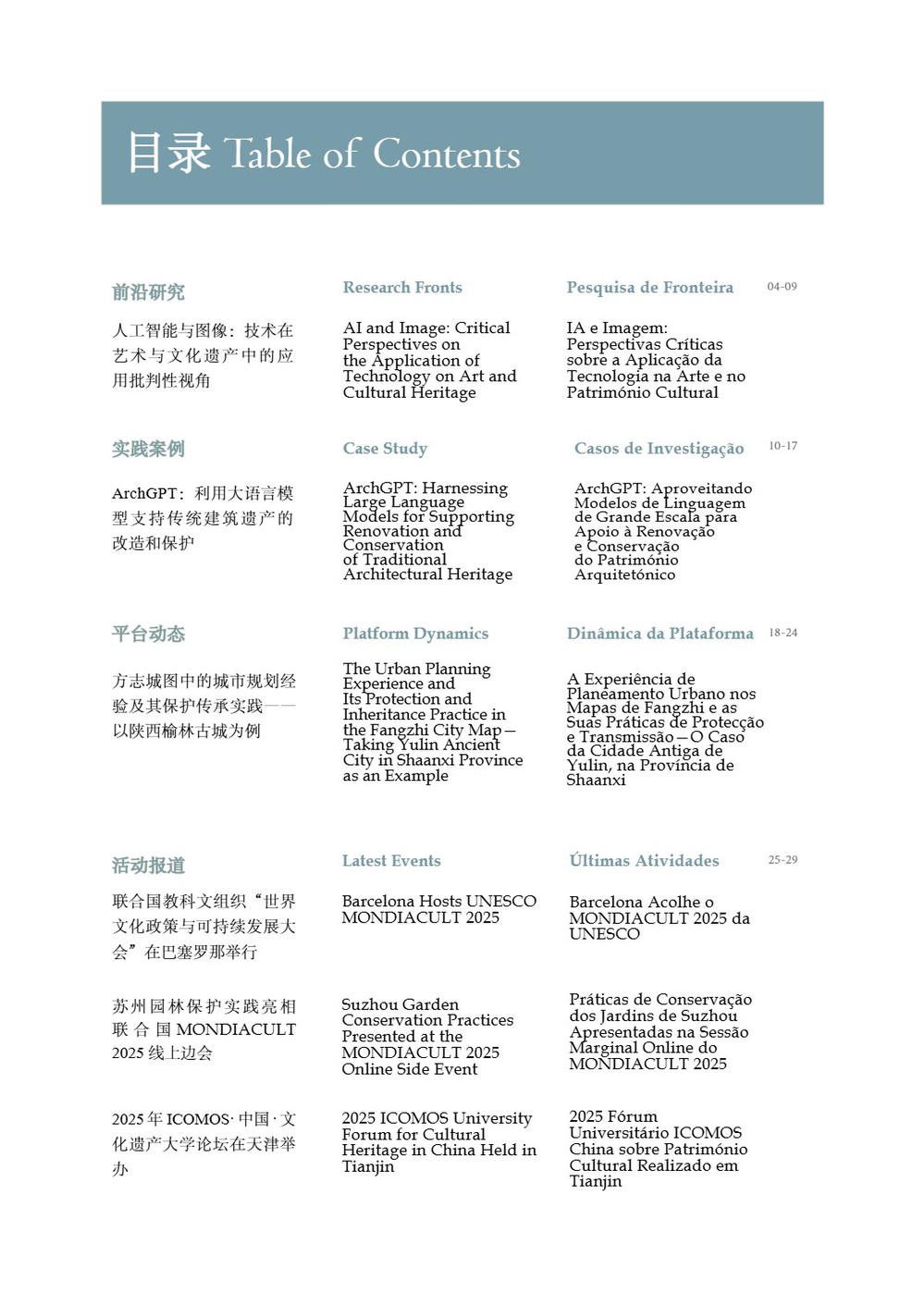
苏州大学联合实验室中英双语双月刊《遗产研究国际动态》(内刊)2025年第六期(总第二十四期)已发布,全刊内容可在此下载
 CPBRJL国家“一带一路“联合实验室《遗产研究国际动态》总第二十四期 The Heritage Spectator No.24.pdf

前沿研究
人工智能与图像:技术在艺术与文化遗产中的应用批判性视角
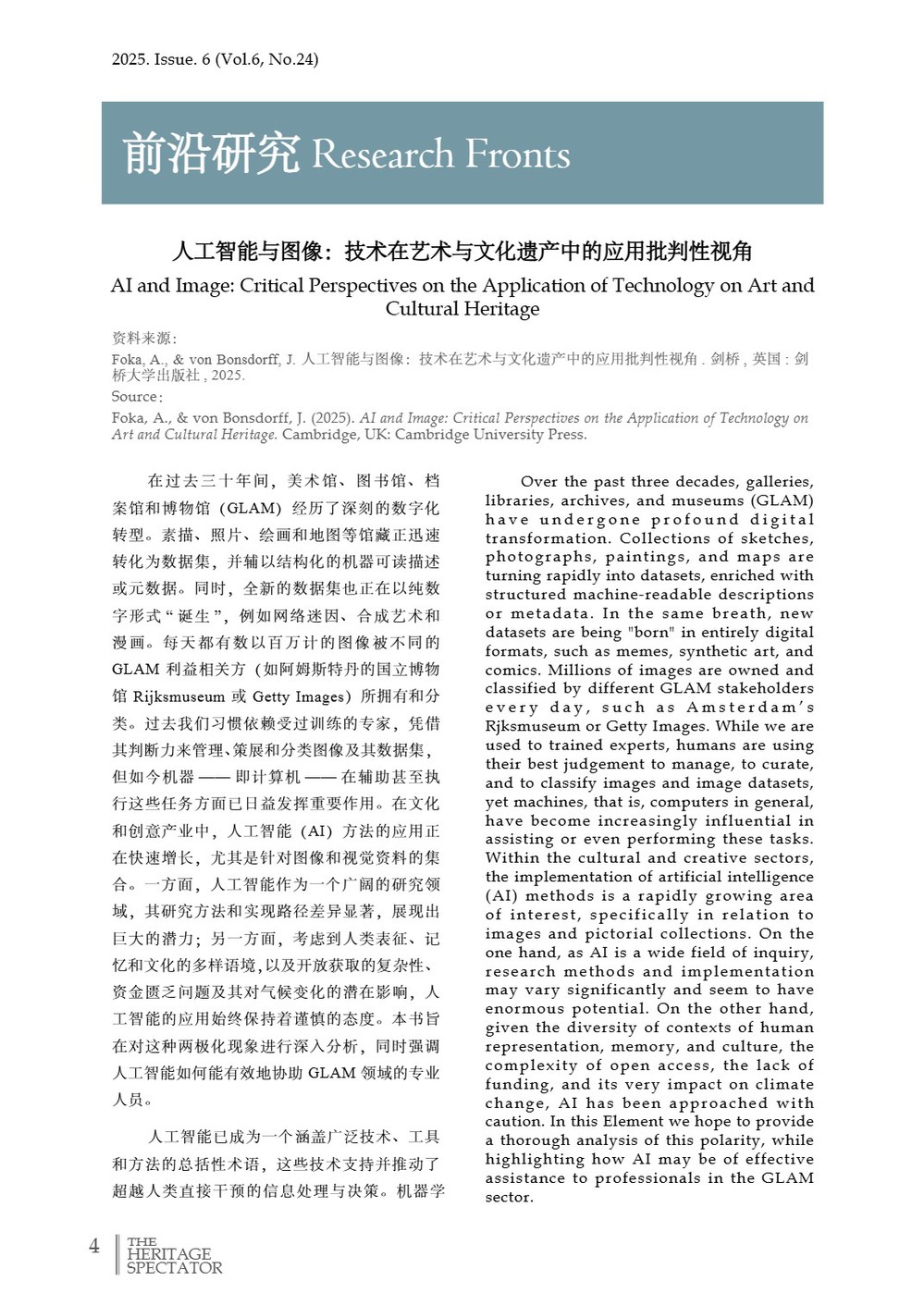
在过去三十年间,美术馆、图书馆、档案馆和博物馆(GLAM)经历了深刻的数字化转型。素描、照片、绘画和地图等馆藏正迅速转化为数据集,并辅以结构化的机器可读描述或元数据。同时,全新的数据集也正在以纯数字形式“诞生”,例如网络迷因、合成艺术和漫画。每天都有数以百万计的图像被不同的 GLAM 利益相关方(如阿姆斯特丹的国立博物馆 Rijksmuseum 或 Getty Images)所拥有和分类。过去我们习惯依赖受过训练的专家,凭借其判断力来管理、策展和分类图像及其数据集,但如今机器——即计算机——在辅助甚至执行这些任务方面已日益发挥重要作用。在文化和创意产业中,人工智能(AI)方法的应用正在快速增长,尤其是针对图像和视觉资料的集合。一方面,人工智能作为一个广阔的研究领域,其研究方法和实现路径差异显著,展现出巨大的潜力;另一方面,考虑到人类表征、记忆和文化的多样语境,以及开放获取的复杂性、资金匮乏问题及其对气候变化的潜在影响,人工智能的应用始终保持着谨慎的态度。本书旨在对这种两极化现象进行深入分析,同时强调人工智能如何能有效地协助 GLAM 领域的专业人员。
AI and Image: Critical Perspectives on the Application of Technology on Art and Cultural Heritage
Over the past three decades, galleries, libraries, archives, and museums (GLAM) have undergone profound digital transformation. Collections of sketches, photographs, paintings, and maps are turning rapidly into datasets, enriched with structured machine-readable descriptions or metadata. In the same breath, new datasets are being "born" in entirely digital formats, such as memes, synthetic art, and comics. Millions of images are owned and classified by different GLAM stakeholders every day, such as Amsterdam’s Rjksmuseum or Getty Images. While we are used to trained experts, humans are using their best judgement to manage, to curate, and to classify images and image datasets, yet machines, that is, computers in general, have become increasingly influential in assisting or even performing these tasks.Within the cultural and creative sectors, the implementation of artificial intelligence (AI) methods is a rapidly growing area of interest, specifically in relation to images and pictorial collections. On the one hand, as AI is a wide field of inquiry, research methods and implementation may vary significantly and seem to have enormous potential. On the other hand, given the diversity of contexts of human representation, memory, and culture, the complexity of open access, the lack of funding, and its very impact on climate change, AI has been approached with caution. In this Element we hope to provide a thorough analysis of this polarity, while highlighting how AI may be of effective assistance to professionals in the GLAM sector.
资料来源:
Foka, A., & von Bonsdorff, J. (2025). AI and Image: Critical Perspectives on the Application of Technology on Art and Cultural Heritage.
Cambridge, UK: Cambridge University Press.
实践案例
ArchGPT:利用大语言模型支持传统建筑遗产的改造和保护
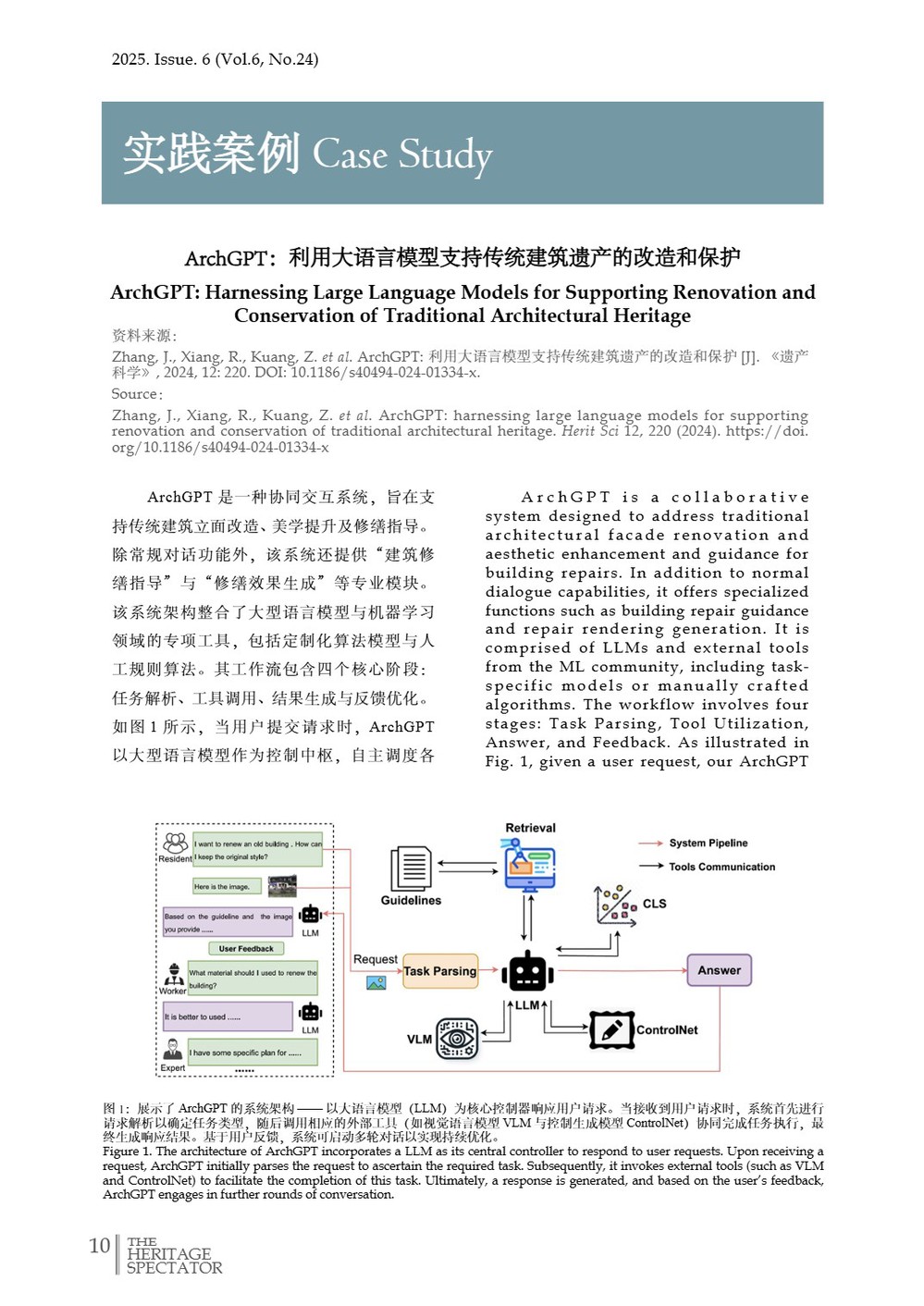
ArchGPT是一种协同交互系统,旨在支持传统建筑立面改造、美学提升及修缮指导。除常规对话功能外,该系统还提供“建筑修缮指导”与“修缮效果生成”等专业模块。该系统架构整合了大型语言模型与机器学习领域的专项工具,包括定制化算法模型与人工规则算法。其工作流包含四个核心阶段:任务解析、工具调用、结果生成与反馈优化。如图1所示,当用户提交请求时,ArchGPT以大型语言模型作为控制中枢,自主调度各类外部工具完成全流程,最终输出目标成果。
作为革命性技术工具,ArchGPT在传统建筑保护与适应性再生中的应用,成功打破了专业知识壁垒,通过人机交互促进了跨学科协作。这既提升了项目执行效率,又凝聚了不同背景利益相关方的共识,助力制定更全面多元的保护更新策略。最重要的是,ArchGPT推动建成既延续历史传统、又满足当代需求的城市建筑改造作品,为传统建筑遗产的创新性保护提供了全新可能。
ArchGPT: Harnessing Large Language Models for Supporting Renovation and Conservation of Traditional
Architectural Heritage
ArchGPT is a collaborative system designed to address traditional architectural facade renovation and aesthetic enhancement and guidance for building repairs. In addition to Normal Dialogue capabilities, it offers specialized functions such as Building Repair Guidance and Repair Rendering Generation. It is comprised of LLMs and external tools from the ML community, including task-specific models or manually crafted algorithms. The workflow involves four stages: Task Parsing, Tool Utilization, Answer, and Feedback. As illustrated in Fig. 1, given a user request, our ArchGPT uses an LLM as the controller to autonomously call upon various external tools to complete the workflow, ultimately producing the desired outcome.
As a revolutionary technological tool, Arch-GPT’s application in the preservation and adaptive reuse of traditional architecture has broken down the barriers of professional knowledge, facilitating interdisciplinary communication and collaboration through human-computer interaction. This not only enhances the efficiency of project implementation but also fosters consensus among stakeholders from diverse backgrounds, contributing to the development of more comprehensive and diverse conservation and renewal strategies. Most importantly, ArchGPT helps to renovate urban renovation architectural works that reflect historical traditions, while meeting the needs of contemporary society and providing new possibilities for innovative protection of traditional architectural heritage.
资料来源:
Zhang, J., Xiang, R., Kuang, Z. et al. ArchGPT: harnessing large language models for supporting renovation and conservation of traditional
architectural heritage. Herit Sci 12, 220 (2024). https://doi.org/10.1186/s40494-024-01334-x
平台动态
方志城图中的城市规划经验及其保护传承实践——以陕西榆林古城为例
随着历史城市保护更新工作不断向纵深推进,构建中国历史城市保护更新的本土化理论体系与技术方法迫在眉睫。本文以榆林方志城图作为研究对象,在榆林地方历史文献与实地踏勘测绘的基础上,通过对榆林相关方志城图的梳理与归纳,分别从自然山水格局、人文空间营造、地方八景营建和军事防御系统四个方面研究,总结其城市的发展演变历程及其规划营造的历史经验,探讨并提出如何在当代城市规划中进行应用与传承的实践策略。
The Urban Planning Experience and Its Protection and Inheritance Practice in the Fangzhi City Map
—Taking Yulin Ancient City in Shaanxi Province as an Example
With the continuous advancement of historical city protection and renewal work, it is urgent to construct a localized theoretical system and technical methods for the protection and renewal of Chinese historical cities. This article takes the Yulin Fangzhi City Map as the research object. Based on the local historical literature and on-site surveying and mapping of Yulin, by sorting and summarizing the relevant Fangzhi City Maps of Yulin, it studies the natural landscape pattern, cultural space creation, local eight scenic construction, and military defense system from four aspects, summarizes the development and evolution process of its city and the historical experience of planning and construction, Explore and propose practical strategies for application and inheritance in contemporary urban planning.
资料来源:
中国- 葡萄牙文化遗产保护科学“一带一路”联合实验室西安研究基地.
活动报道
联合国教科文组织“世界文化政策与可持续发展大会”在巴塞罗那举行
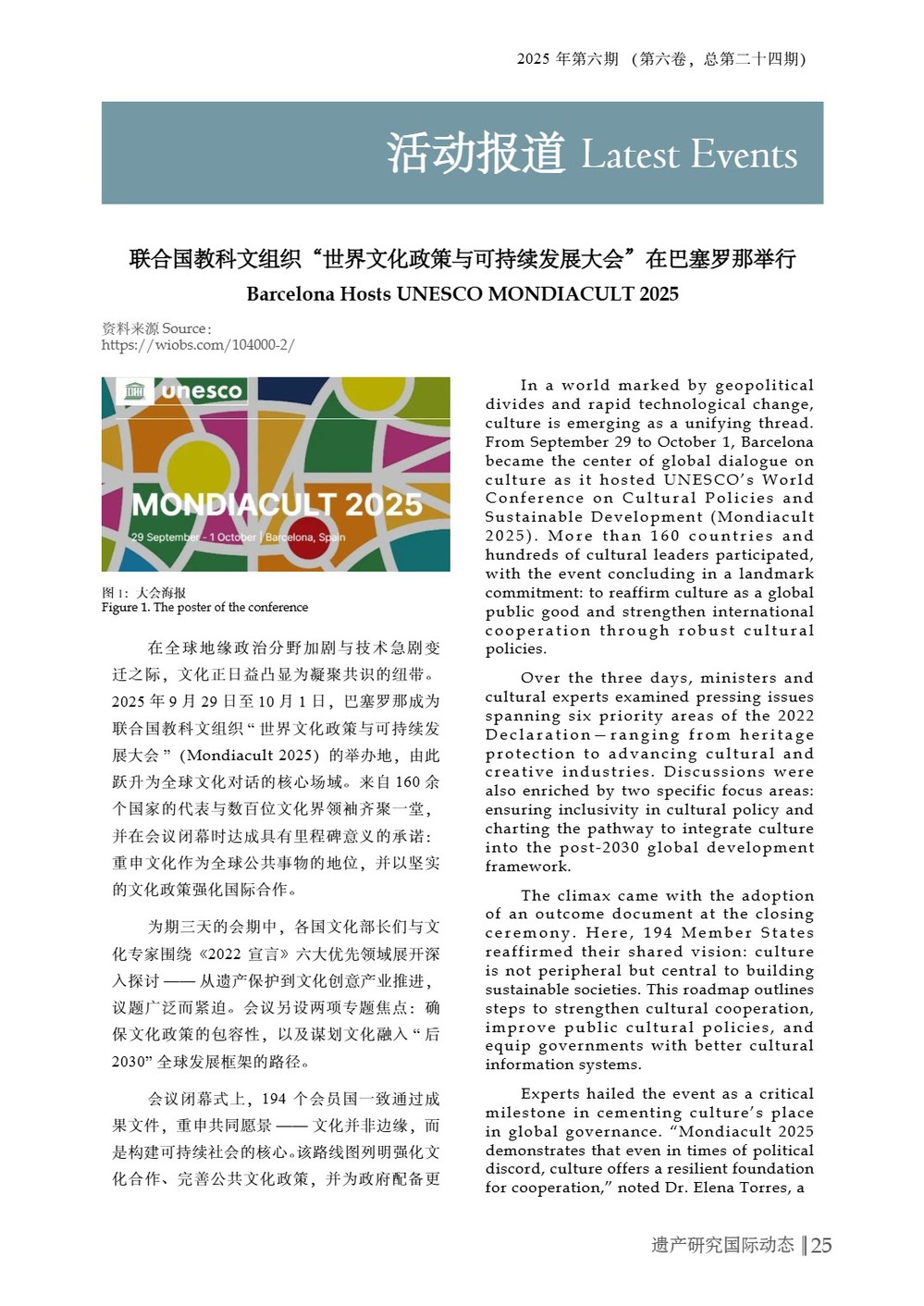
在全球地缘政治分野加剧与技术急剧变迁之际,文化正日益凸显为凝聚共识的纽带。2025年9月29日至10月1日,巴塞罗那成为联合国教科文组织“世界文化政策与可持续发展大会”(Mondiacult 2025)的举办地,由此跃升为全球文化对话的核心场域。来自160余个国家的代表与数百位文化界领袖齐聚一堂,并在会议闭幕时达成具有里程碑意义的承诺:重申文化作为全球公共事物的地位,并以坚实的文化政策强化国际合作。
为期三天的会期中,各国文化部长们与文化专家围绕《2022 宣言》六大优先领域展开深入探讨——从遗产保护到文化创意产业推进,议题广泛而紧迫。会议另设两项专题焦点:确保文化政策的包容性,以及谋划文化融入“后 2030”全球发展框架的路径。
Barcelona Hosts UNESCO MONDIACULT 2025
In a world marked by geopolitical divides and rapid technological change, culture is emerging as a unifying thread. From September 29 to October 1, Barcelona became the center of global dialogue on culture as it hosted UNESCO’s World Conference on Cultural Policies and Sustainable Development (Mondiacult 2025). More than 160 countries and hundreds of cultural leaders participated, with the event concluding in a landmark commitment: to reaffirm culture as a global public good and strengthen international cooperation through robust cultural policies.
Over the three days, ministers and cultural experts examined pressing issues spanning six priority areas of the 2022 Declaration—ranging from heritage protection to advancing cultural and creative industries. Discussions were also enriched by two specific focus areas: ensuring inclusivity in cultural policy and charting the pathway to integrate culture into the post-2030 global development framework.
苏州园林保护实践亮相联合国MONDIACULT 2025线上边会
9月19日至30日,由联合国教科文组织亚太地区世界遗产培训与研究中心苏州分中心主办的《文化赋能城市可持续发展——苏州园林群体保护的启示》线上主题展(观展请点击:https://www.sinowh.org.cn/zt/whfn/)率先拉开帷幕,向全球展示中国古典园林活态传承的实践成果,为全球文化遗产保护与城市可持续发展提供“苏州方案”。
此次参会是苏州园林保护实践再一次登上联合国舞台。自1997年列入《世界遗产名录》以来,苏州始终以“保护为先、活化利用”为原则,先后获“亚洲都市景观奖”“亚太遗产保护杰出奖”等荣誉。未来,苏州将持续深化“园林之城”建设,让千年园林在新时代焕发更大的全球价值。
Suzhou Garden Conservation Practices Presented at the MONDIACULT 2025 Online Side Event
From 19 to 30 September 2025, the online thematic exhibition “Culture-Enabled Sustainable Urban Development: Insights from the Cluster Conservation of Suzhou Gardens”—organized by the UNESCO World Heritage Training and Research Centre for the Asia-Pacific Region (Suzhou Office)—was officially launched. Accessible at https://www.sinowh.org.cn/zt/whfn/, the exhibition disseminates worldwide the results of living heritage transmission in China’s classical gardens and offers a replicable “Suzhou Model” for integrating cultural heritage conservation into sustainable urban development.
Participation in MONDIACULT 2025 marks Suzhou’s latest appearance on the UN stage. Since inscription in 1997, the city has adhered to the principle “conservation first, adaptive use,” earning accolades such as the Asian Townscape Award and the UNESCO Asia-Pacific Heritage Award for Outstanding Achievement. Going forward, Suzhou will deepen the Garden City programme, ensuring that millennium-old landscapes continue to generate global value in the new era.
2025年 ICOMOS·中国·文化遗产大学论坛在天津举办
9月20日,天津大学联合中国古迹遗址保护协会(ICOMOS China)、尼泊尔古迹遗址保护协会(ICOMOS Nepal)共同主办第二届ICOMOS中国大学文化遗产论坛。来自中国、法国、尼泊尔、意大利、英国、日本、韩国、比利时及印度尼西亚等9个国家的百余位专家、学者与研究生参会。本届论坛以“文化遗产·交叉创新”为主题,集中探讨遗产保护、研究与教育的新路径。
来自高校、管理机构与国际组织的代表围绕景观管理策略、创新保护技术、保护教育未来与国际合作等议题分享案例。法国古迹遗址保护协会主任伊莎贝尔·帕尔米(Isabelle Palmi)介绍了法国以综合景观管理促进生态与社会转型的经验;印度尼西亚古迹遗址保护协会主席苏哈迪·哈托诺(Soehardi Hartono)展示了运用“历史城市景观”(HUL)方法复兴历史市政广场的创新策略。政府代表、遗产管理者与学者在圆桌环节展开深入对话。
2025 ICOMOS University Forum for Cultural Heritage in China Held in Tianjin
On 20 September, Tianjin University hosted the Second ICOMOS University Forum for Cultural Heritage, in collaboration with ICOMOS China and ICOMOS Nepal. More than 100 experts, scholars, and students from 9 countries (China, France, Nepal, Italy, the UK, Japan, Republic of Korea, Belgium, and Indonesia) participated in the event. Structured around the theme “Cultural Heritage – Interdisciplinary Innovation,” it provided an opportunity for attendees to explore new approaches for heritage protection, research, and education.
Among the speakers were leading academics, heritage managers, and international experts. They presented case studies on topics ranging from landscape-based management strategies and innovative conservation technologies, to the future of conservation education and international cooperation. ICOMOS France Director Isabelle Palmi gave examples of integrated landscape management used as a tool for ecological and social transformation in France. Soehardi Hartono, President of ICOMOS Indonesia, presented innovative strategies for reviving historic civic squares, applying the Historic Urban Landscape (HUL) approach. Government representatives, heritage managers and scholars engaged in lively roundtable discussions.
资料来源:
https://www.whitr-ap.org/index.php?classid=1518&newsid=3874&t=show
https://www.icomos.org/actualite/second-icomos-university-forum-for-cultural-heritage-in-china/