
 英文版
 苏州大学
联合实验室中英双语双月刊《遗产研究国际动态》(内刊)2026年第五期(总第二十九期)已发布,全刊内容可在此下载
 JLBRI国家“一带一路“联合实验室《遗产研究国际动态》总第二十九期The Heritage Spectator No.29.pdf




前沿研究
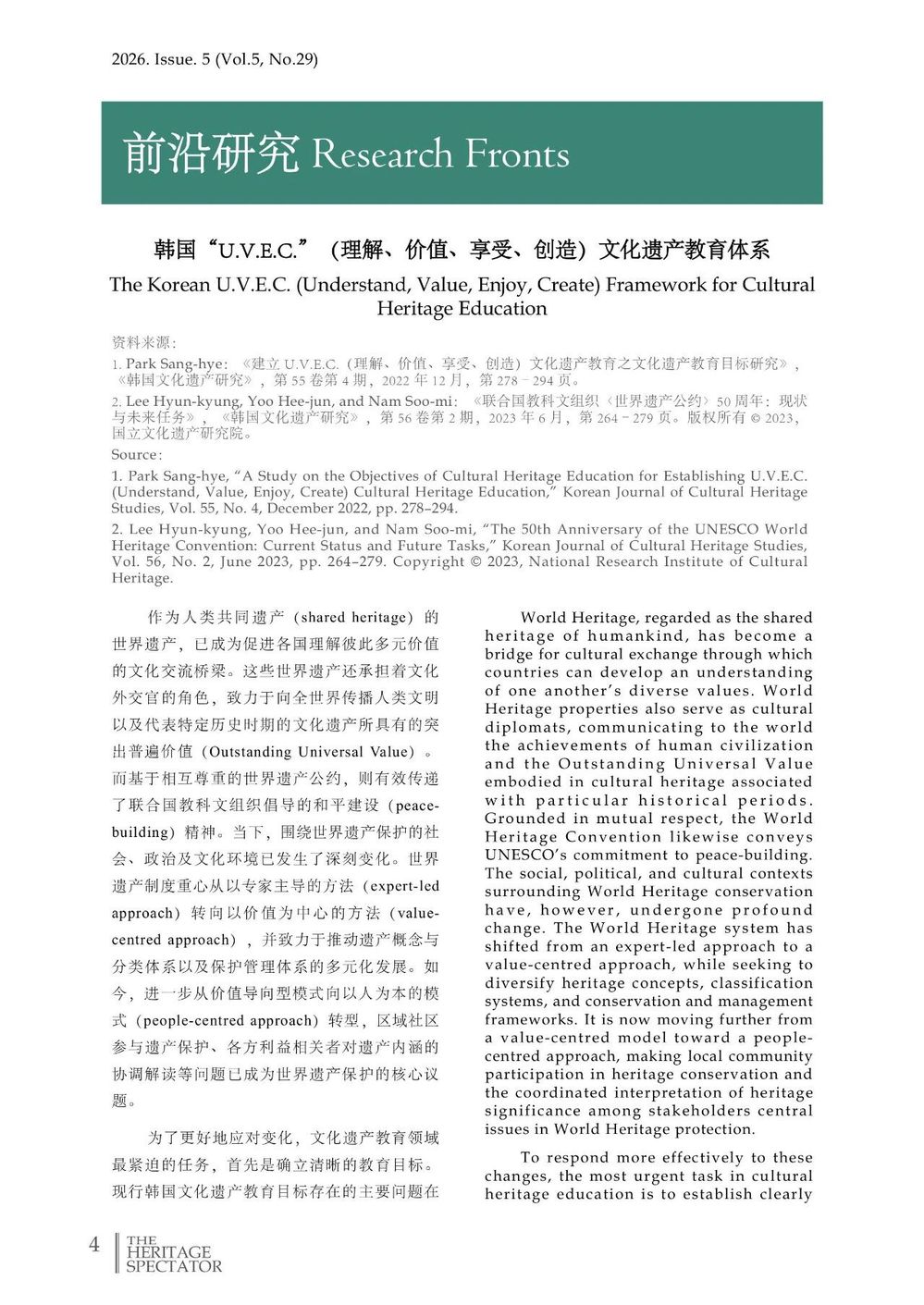
韩国“U.V.E.C.”(理解、价值、享受、创造)文化遗产教育体系
当下,围绕世界遗产保护的社会、政治及文化环境已发生了深刻变化。世界遗产制度重心从以专家主导的方法(expert-led approach)转向以价值为中心的方法(value-centred approach),并致力于推动遗产概念与分类体系以及保护管理体系的多元化发展。如今,进一步从价值导向型模式向以人为本的模式(people-centred approach)转型,区域社区参与遗产保护、各方利益相关者对遗产内涵的协调解读等问题已成为世界遗产保护的核心议题。
为了更好地应对变化,文化遗产教育领域最紧迫的任务,首先是确立清晰的教育目标。现行韩国文化遗产教育目标存在的主要问题在于:相关从业者对教育目标的概念理解不够准确;教育目标未能充分反映教学的实际内容;同时,这些目标未能充分考虑学习者的多样化能力与兴趣需求,也未能适应时代发展的变化。因此,韩国提出了“U.V.E.C文化遗产教育”的新型文化遗产教育理念。旨在帮助人们理解文化遗产(Understand)、认识其价值(Value)、享受其魅力(Enjoy)并促进文化创新(Create)的教育形式。
The social, political, and cultural contexts surrounding World Heritage conservation have, however, undergone profound change. The World Heritage system has shifted from an expert-led approach to a value-centred approach, while seeking to diversify heritage concepts, classification systems, and conservation and management frameworks. It is now moving further from a value-centred model toward a people-centred approach, making local community participation in heritage conservation and the coordinated interpretation of heritage significance among stakeholders central issues in World Heritage protection.
To respond more effectively to these changes, the most urgent task in cultural heritage education is to establish clearly defined educational objectives. The principal shortcomings of current objectives in Korean cultural heritage education are as follows: practitioners lack a precise conceptual understanding of educational objectives; the stated objectives do not adequately reflect the actual content of instruction; and they neither sufficiently accommodate learners’ diverse abilities and interests nor respond to contemporary change. Against this background, Korea has proposed the concept of “U.V.E.C. cultural heritage education,” an educational model designed to enable learners to Understand cultural heritage, recognize its Value, Enjoy its appeal, and contribute to cultural Creation.
资料来源:
Park Sang-hye:《建立U.V.E.C.(理解、价值、享受、创造)文化遗产教育之文化遗产教育目标研究》,《韩国文化遗产研究》,第55卷第4期,2022年12月,第278–294页。
Lee Hyun-kyung, Yoo Hee-jun, and Nam Soo-mi:《联合国教科文组织〈世界遗产公约〉50周年:现状与未来任务》,《韩国文化遗产研究》,第56卷第2期,2023年6月,第264–279页。版权所有 © 2023,国立文化遗产研究院。
实践案例
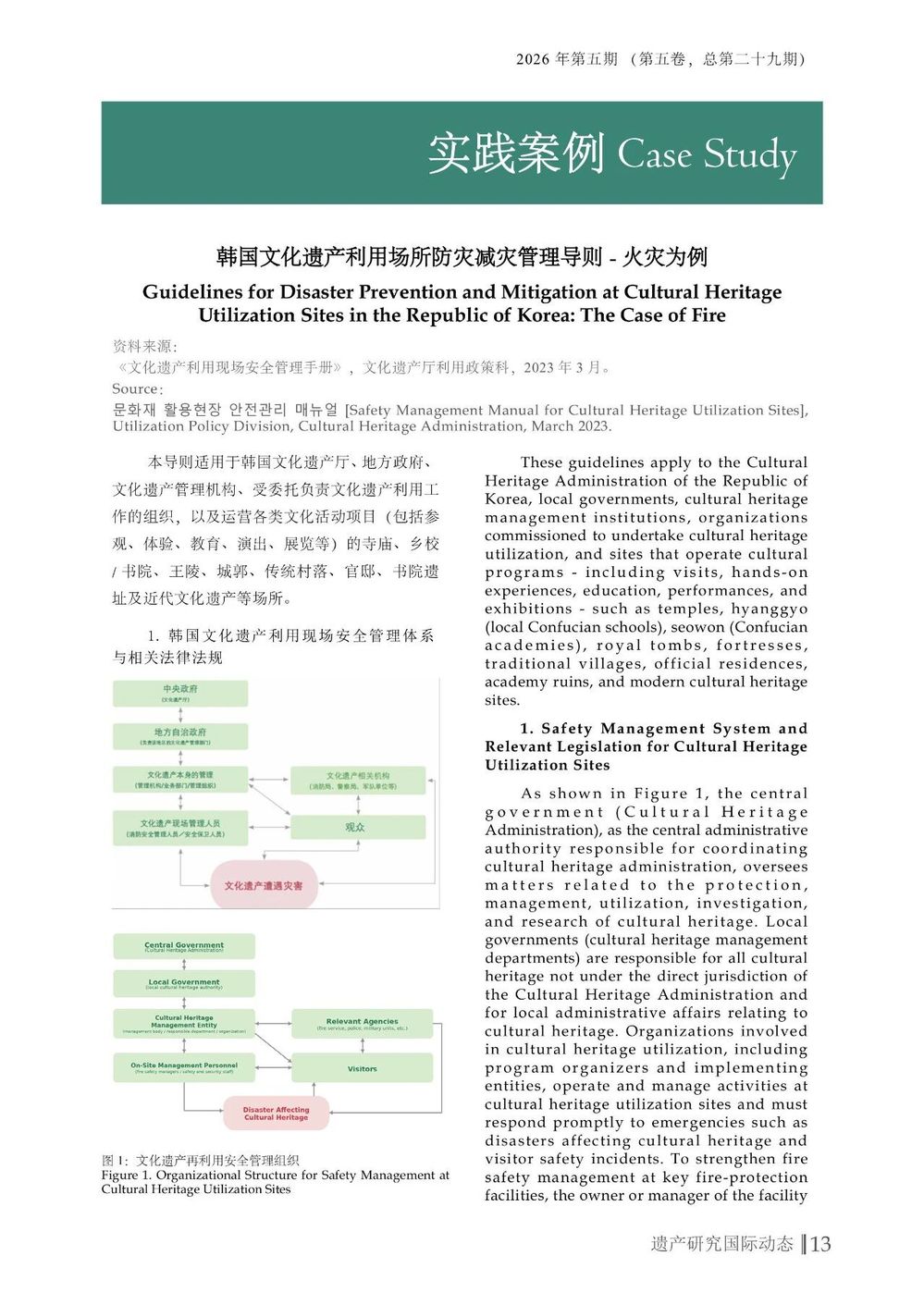
韩国文化遗产利用场所防灾减灾管理导则-火灾为例
本导则适用于韩国文化遗产厅、地方政府、文化遗产管理机构、受委托负责文化遗产利用工作的组织,以及运营各类文化活动项目(包括参观、体验、教育、演出、展览等)的寺庙、乡校/书院、王陵、城郭、传统村落、官邸、书院遗址及近代文化遗产等场所。
These guidelines apply to the Cultural Heritage Administration of the Republic of Korea, local governments, cultural heritage management institutions, organizations commissioned to undertake cultural heritage utilization, and sites that operate cultural programs - including visits, hands-on experiences, education, performances, and exhibitions - such as temples, hyanggyo (local Confucian schools), seowon (Confucian academies), royal tombs, fortresses, traditional villages, official residences, academy ruins, and modern cultural heritage sites.
资料来源:
《文化遗产利用现场安全管理手册》,文化遗产厅利用政策科,2023年3月。
平台动态
哥伦比亚国家博物馆藏“弗朗西斯科·皮萨罗纹章旗”:多分析技术方法助力揭示历史
历史与考古纺织品在文化遗产研究中始终具有重要意义,因为其制作往往与当时实际使用的原材料密切相关,例如纺织纤维、天然染料以及金属线,而这些材料反过来又可能与制品的生产地点和年代存在紧密联系。
本研究聚焦于一面现藏于哥伦比亚国家博物馆的旗帜。据认为,这面旗帜曾由弗朗西斯科·皮萨罗在1532年征服今秘鲁地区时使用。据称,在秘鲁独立战争期间,安东尼奥·何塞·德·苏克雷将军从库斯科大教堂取走了这面旗帜,并于1825年在哥伦比亚波哥大将其交给政治与军事领袖西蒙·玻利瓦尔。旗帜中央为卡斯蒂利亚和莱昂纹章,使用黄、红、蓝色丝织物构成,外围环绕金羊毛骑士团链饰。纹章和绿色条带上可见金、银金属线。由于南美洲其他地点还保存着两面相似的旗帜,哥伦比亚国家博物馆所藏这面旗帜的真实性长期以来一直是学者与政治人物争论的话题。历史资料也保留了另一种可能性,即该旗可能是西班牙国王卡洛斯一世的正式王旗,并曾用于西班牙征服印加帝国的过程中。
Historical/Archaeological textiles have been always of significance to cultural heritage studies because their manufacturing can be related to the use of the raw materials originally used such as textile fibres (cotton, silk, linen), natural dyes (cochineal, weld, indigo, etc.) and metal threads (silver, gold) that, in turn, may be strictly linked to the location and time period of their production.
The study focuses on a banner, currently stored at the National Museum of Colombia, and believed to be the one used by Francisco Pizarro during the 1532 conquest of the region that is currently Peru (see fig. 1). Supposedly, it was General Antonio Jos´e de Sucre who, during the Peruvian war of independence, removed this banner from the Cathedral of Cuzco, handing it to the political and military leader Simon Bolivar in Bogota, Colombia, in 1825. The Banner has the emblem of Castilla and Leon (with yellow, red and blue silks) in the center surrounded by the Chain of the Order of the Golden Fleece. Metal threads (gold and silver) are visible in the emblem’s Banner and in the green stripe”. Due to the existence of two similar flags/banners at other South America locations, the Colombia National Museum’s banner authenticity has always been a matter of debate among scholars and politicians. Historical sources leave open the option that the same banner could be the official Royal Banner of King Charles I of Spain, which was used during the Spanish conquest of the Inca Empire.
资料来源:
HERCULES 实验室,埃武拉大学,葡萄牙埃武拉Marquês de Marialva 广场8 号,7000-809
埃武拉大学,科学与技术学院化学系,葡萄牙埃武拉Romão Ramalho 街59 号,7000-671
活动报道
第48届世界遗产委员大会在韩国釜山闭幕
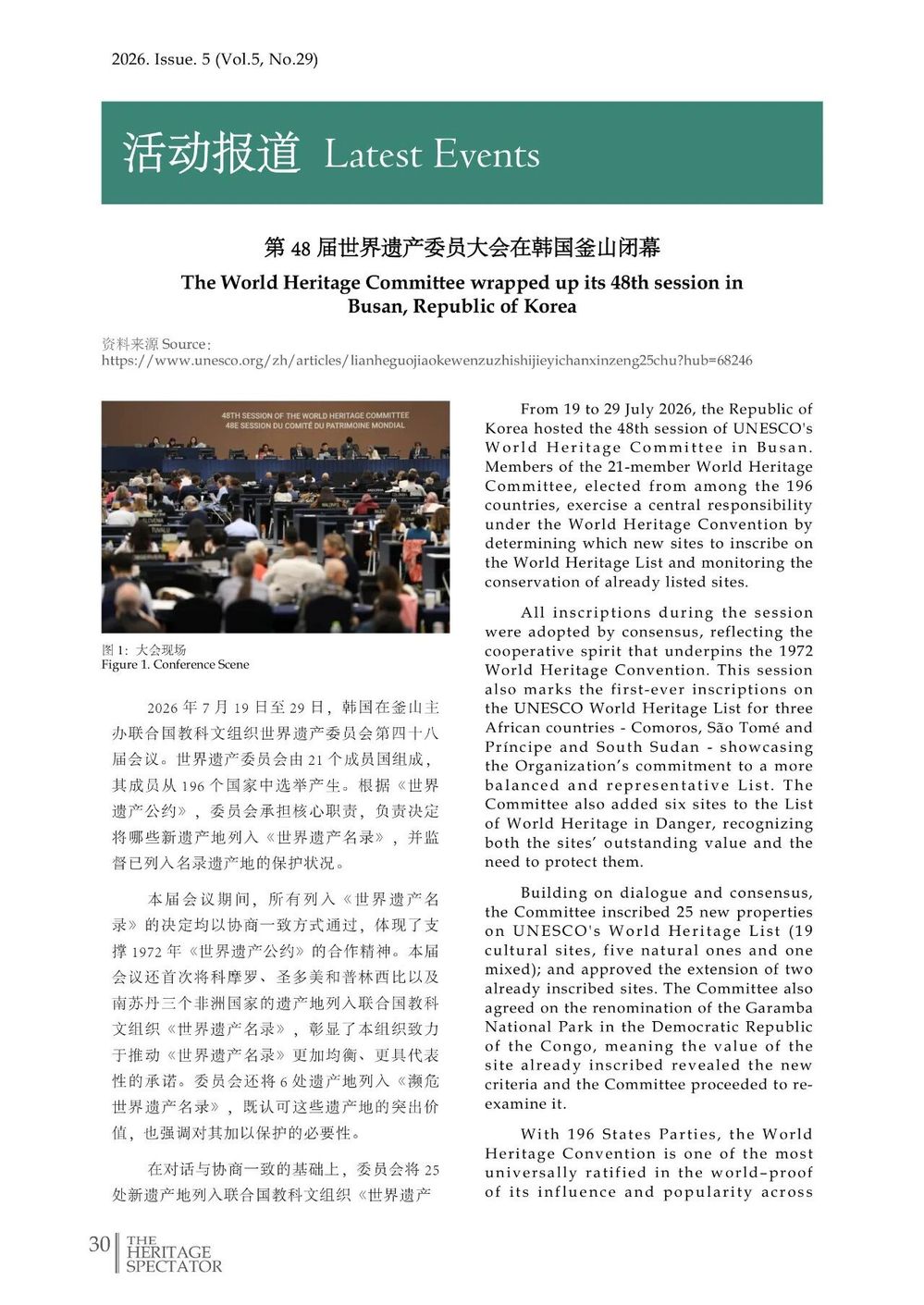
2026年7月19日至29日,韩国在釜山主办联合国教科文组织世界遗产委员会第四十八届会议。世界遗产委员会由21个成员国组成,其成员从196个国家中选举产生。根据《世界遗产公约》,委员会承担核心职责,负责决定将哪些新遗产地列入《世界遗产名录》,并监督已列入名录遗产地的保护状况。
The World Heritage Committee wrapped up its 48th session in Busan, Republic of Korea
From 19 to 29 July 2026, the Republic of Korea hosted the 48th session of UNESCO's World Heritage Committee in Busan. Members of the 21-member World Heritage Committee, elected from among the 196 countries, exercise a central responsibility under the World Heritage Convention by determining which new sites to inscribe on the World Heritage List and monitoring the conservation of already listed sites.
2026国际文化遗产保护活动周启幕
2026年7月15日晚,“美美与共 共筑未来”2026国际文化遗产保护活动周在山西省晋中市榆次老城启动。约旦、北马其顿、马尔代夫、拉脱维亚、孟加拉国驻华大使,国际文博专家、海外汉学家等,聚焦文化遗产保护与文明国际互鉴,以古今交融、中外联动的形式,开启一场跨越时空的文化对话。
2026 International Cultural Heritage Conservation Week Opens
On the evening of July 15, 2026, the 2026 International Cultural Heritage Conservation Week, themed “Beauty in Harmony, Building the Future Together,” opened in the Ancient City of Yuci in Jinzhong, Shanxi Province. Ambassadors to China from Jordan, North Macedonia, the Maldives, Latvia and Bangladesh, together with international museum and cultural heritage experts and overseas sinologists, gathered around the themes of cultural heritage conservation and international exchanges and mutual learning among civilizations.
中国—东盟建筑遗产数字信息系统与可持续更新研讨会
2026年7月30日,“中国—东盟建筑遗产数字信息系统与可持续更新研讨会”在贵阳中国—东盟教育交流周永久会址2楼东盟论坛厅举行。本次研讨会聚焦建筑遗产的数字化保护与可持续更新,汇聚了中国与东盟国家政府部门、国际组织、高校及驻华使馆的代表,旨在共同探讨数字技术赋能文化遗产保护与区域合作的新路径。
China–ASEAN Symposium on Digital Information Systems and Sustainable Renewal for Architectural Heritage
On July 30, 2026, the China–ASEAN Symposium on Digital Information Systems and Sustainable Renewal for Architectural Heritage was held in the ASEAN Forum Hall on the second floor, professionals from the fields of the permanent venue of the China–ASEAN Education Cooperation Week in Guiyang. The symposium focused on the digital conservation and sustainable renewal of architectural heritage. It brought together representatives from government departments, international organizations, universities and embassies in China and ASEAN countries to explore new pathways for leveraging digital technologies to advance cultural heritage conservation and regional cooperation.
资料来源:公开新闻报道