
 中文版
中文版 Soochow University
 Search
Zhao Qiang, the first postdoctoral fellow of the Joint Laboratory and a cultural heritage expert from Macau, has successfully completed a six-month academic visit and exchange at the Palace Museum as a "Taihe Scholar." Dr. Zhao Qiang is the first scholar from the Hong Kong and Macau regions to complete the Palace Museum's "Taihe Scholar Program." This exchange marks a new breakthrough for the Joint Laboratory in high-level talent cultivation and international academic dialogue.
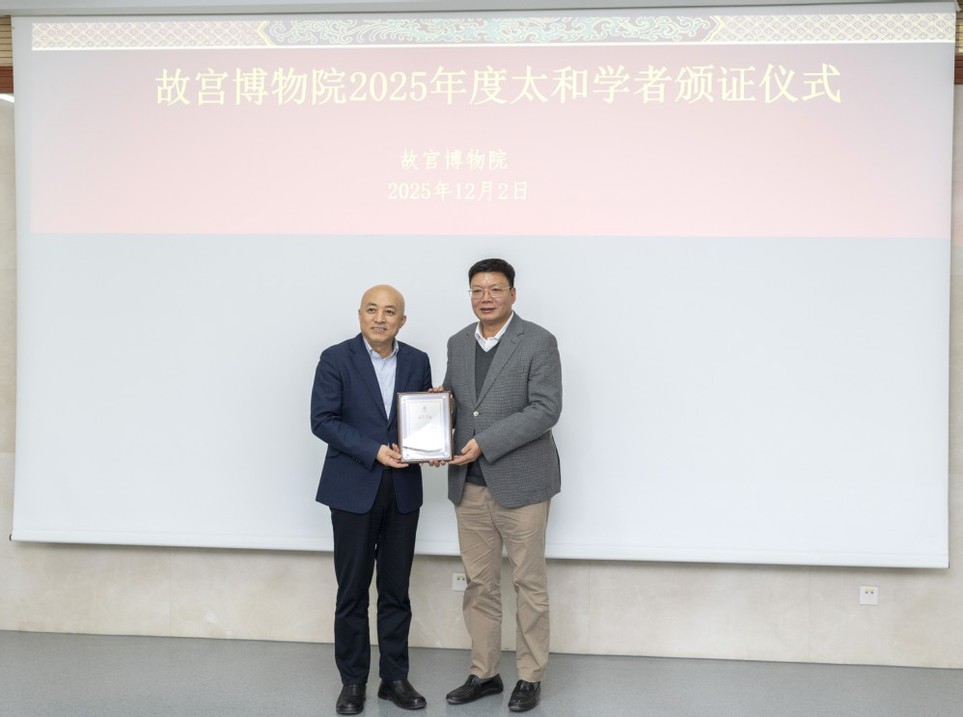
During his exchange at the Palace Museum, Dr. Zhao Qiang leveraged the museum's extensive collection and advanced cultural heritage conservation technologies to establish an integrated research system combining "traditional visual appraisal, documentary evidence, and technological assistance." He systematically interpreted the historical significance of 16th- and 17th-century export porcelain (Kraak ware) and, using these artifacts as a lens, provided empirical evidence for Macau's historical role as a key node on the Maritime Silk Road. His research applied technological methods such as optical digital twins to meticulously reveal the fusion of Eastern and Western craftsmanship and aesthetics within the artifacts, offering a new paradigm for the technological preservation and interpretation of cultural heritage.
Dr. Zhao Qiang's academic journey not only represents a showcase of his personal research achievements but also serves as a vivid example of the Joint Laboratory's active efforts to promote mutual learning and collaboration within the framework of the Belt and Road Initiative. As a flagship institution in China's cultural heritage and museum sector, the Palace Museum has established the China-Greece Joint Laboratory of Cultural Heritage Conservation Technology, which has achieved notable results in the conservation of movable cultural relics and stone artifacts. The Joint Laboratory, leveraging its own distinct strengths, focuses on the field of architectural and urban heritage preservation, serving as a key national platform for technological cooperation and innovation in this area. While the two laboratories concentrate on different types of heritage, they share a common mission: to safeguard humanity's shared cultural heritage through scientific and technological means and to foster exchanges and mutual learning among civilizations.
This exchange, facilitated by the "Taihe Scholar" program, has established direct and in-depth connections between the two joint laboratories, as well as between the laboratory and top-tier domestic research institutions such as the Palace Museum, laying a solid foundation for further related cooperation. Moving forward, the Joint Laboratory will continue to leverage its unique strengths to deepen research in the field of architectural heritage preservation. At the same time, it will adopt a more open approach, joining hands with leading institutions both at home and abroad to contribute wisdom and strength to the sustainable development and international collaboration of cultural heritage conservation.