
 中文版
 Soochow University
 Search
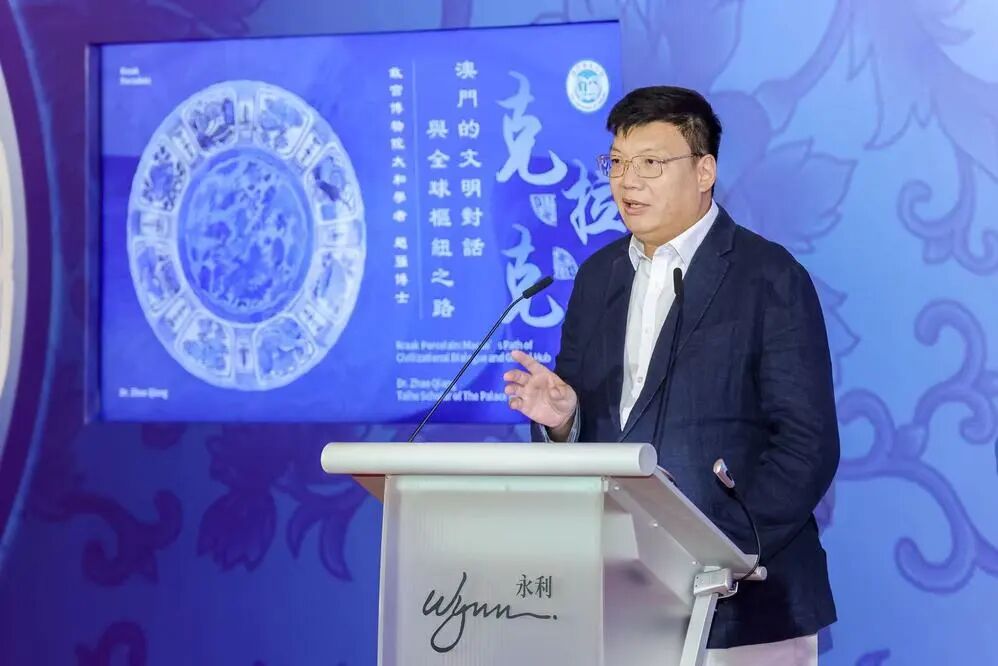
Recently, Zhao Qiang, the first postdoctoral researcher at the China-Portugal Belt and Road Joint Laboratory on Cultural Heritage Conservation Science (hereinafter referred to as the Joint Laboratory), Taihe Scholar of the Palace Museum and Macao cultural heritage expert, delivered an in-depth interpretation of the World Heritage site of Jingdezhen, illustrating Macao’s value as a Maritime Silk Road hub through which Jingdezhen porcelain spread across the globe. Leveraging the strengths of the tripartite platform jointly built by Soochow University, City University of Macau and the University of Évora, the Joint Laboratory continues to conduct in-depth research on Maritime Silk Road ceramic heritage to facilitate exchanges and mutual learning between Chinese and foreign civilizations.
On 25 July local time, at the 48th session of the UNESCO World Heritage Committee held in Busan, the Republic of Korea, China’s “Jingdezhen Traditional Porcelain Production Remains” was officially inscribed on the World Heritage List. This completes the representation of China’s three major cultural carriers of ancient foreign trade — silk, tea and porcelain — within the World Heritage framework, showcasing to the world the glorious history of the profound integration of Chinese handicrafts and early globalization.
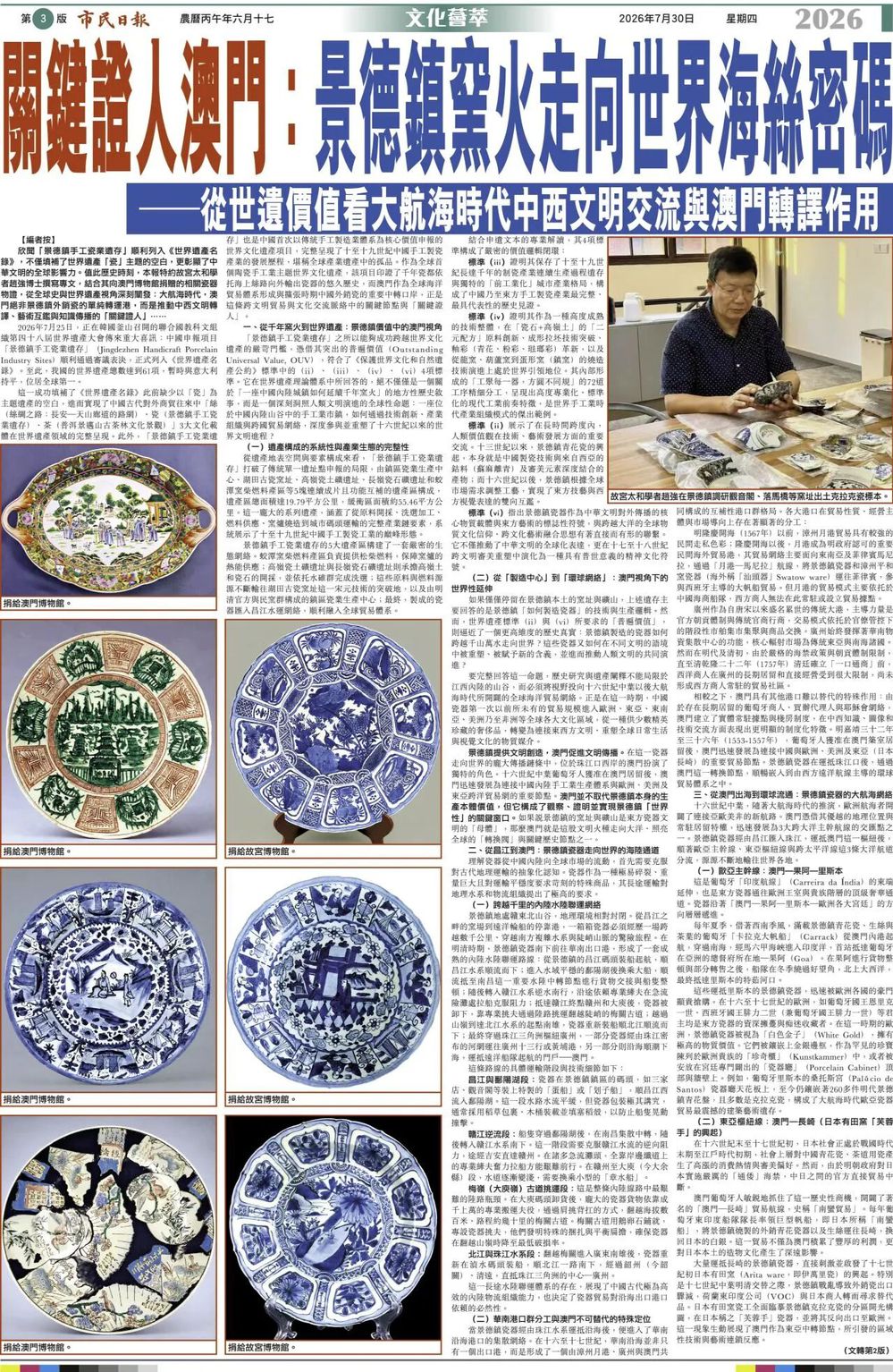
For the interpretation of the outstanding universal value of Jingdezhen World Heritage, Zhao Qiang was invited for an exclusive interview by the East-West Questions column of China News Service, titled Why Macao is the "Maritime Silk Road Code" for Jingdezhen’s World Heritage Inscription. His relevant research findings were also published on 30 July 2026 in the cultural feature Macao, the Key Witness: The Maritime Silk Road Code of Jingdezhen Kiln Fire Spreading Worldwide in Macao’s Jornal do Cidadão. As the first Taihe Scholar of the Palace Museum from Hong Kong and Macao regions, Zhao Qiang has long devoted himself to the research of export porcelain along the Maritime Silk Road dating back to the 16th and 17th centuries. Drawing on the abundant collections and advanced heritage conservation technologies of the Palace Museum, he innovatively established an integrated research framework combining traditional visual appraisal, documentary verification and scientific and technical authentication. Applying cutting-edge technologies such as optical digital twin, he meticulously reconstructs the integrated characteristics of Eastern and Western craftsmanship and aesthetics. With scientific evidence, he clarifies the circulation routes of export porcelain and confirms Macao’s historical position as a Maritime Silk Road hub, building a brand-new research paradigm for scientific interpretation and revitalized conservation of Maritime Silk Road cultural heritage.
Built upon solid academic accumulation, he put forward an in-depth interpretation: Macao serves as an indispensable “Maritime Silk Road Code” that demonstrates the outstanding value of Jingdezhen World Heritage and interprets the global dissemination history of Chinese porcelain, and a vital “key witness” that completes the narrative of Jingdezhen World Heritage. As a transfer node where Western oceanic routes met indigenous East Asian routes in the 16th and 17th centuries, Macao closely connected Jingdezhen’s inland production system with markets in Europe, Japan and the Americas. Through three major oceanic trade routes — Eurasian, East Asian and trans-Pacific — Jingdezhen porcelain became a core material medium of early globalization. He stressed that a large quantity of shards of Jingdezhen folk kiln Kraak porcelain unearthed at the Ruins of St. Paul’s College in Macao provide critical archaeological evidence proving Macao’s role as an important transit port on the Maritime Silk Road, bearing witness to the profound integration of maritime trade, religious propagation and cultural exchange.
As an important platform serving national strategies and people-to-people exchanges between China and foreign countries, the Joint Laboratory is deeply engaged in cultural heritage conservation and exchanges between China and Portugal as well as China and the West. It once provided 34 precious Kraak porcelain exhibits for the Jingdezhen · Macao: Maritime Silk Road Porcelain Light Digital Art Exhibition held in Macao. The exhibition attracted wide attention, with He Houhua, Vice Chairman of the National Committee of the Chinese People’s Political Consultative Conference, and other Chinese and foreign dignitaries visiting the show. Centered on scientific research, technological innovation and international cooperation, the Joint Laboratory acts as an important bridge in cross-border artefact provenance research, cross-cultural heritage conservation and civilizational exchange and mutual learning. It continuously offers technical support and academic guarantee for the conservation of Maritime Silk Road cultural heritage and relics of Sino-foreign exchanges.
In the future, the Joint Laboratory will continue to focus on key cultural heritage research subjects including Jingdezhen and the Macao Maritime Silk Road porcelain route, and deepen Sino-Portuguese academic cooperation and archaeological research. Supported by digital technologies and heritage conservation science, it will promote the revitalization, utilization and international communication of cultural heritage. The laboratory will keep serving national strategies and high-level exchanges, take cultural heritage as a bond to deepen dialogue between Chinese and foreign civilizations, tell stories of exchanges and mutual learning between China and the world, and contribute more research strength to the cause of cultural heritage conservation.